 blog
blog
Best Aesthetic Clinics in Bath UK: 2026 Comparison Guide
Table of Contents
- What Separates a Medical Aesthetic Clinic from a Beauty Salon
- How to Choose a Safe Aesthetic Practitioner in Bath
- Why CQC Registered Aesthetic Clinics in Bath Matter
- The Medical Aesthetics Consultation Process Explained
- Treatments You Can Expect from the Best Aesthetic Clinics in Bath UK
- Aftercare, Recovery and Long-Term Skin Health
- How to Compare Value at the Best Aesthetic Clinics in Bath UK
- Frequently Asked Questions
Last Updated: September 29, 2026
What Separates a Medical Aesthetic Clinic from a Beauty Salon
A medical aesthetic clinic is a healthcare setting where medically qualified practitioners deliver treatments to clinical standards; a beauty salon focuses on cosmetic pampering. This distinction determines who can prescribe, what can legally be offered, and how your safety is protected. This guide from Exclusive Medical Aesthetics breaks down how to find the best aesthetic clinics in Bath UK.
How to Choose a Safe Aesthetic Practitioner in Bath
Choosing a safe practitioner means checking three things: registration, insurance, and prescriber access.
Credentials, Insurance and Prescriber Access
Start with the register. Doctors appear on the General Medical Council register, nurses on the Nursing and Midwifery Council register, and dentists on the General Dental Council register, all free to check online.
First-Time Patient Safety Checklist
Use this checklist before booking any treatment:
- Practitioner is registered with GMC, NMC, or GDC
- Clinic holds current CQC registration where required
- You can name the prescriber overseeing your care
- A full medical history and consent process takes place
- You are told the product name and batch details
- Written aftercare and emergency contact details are provided
- A follow-up review is offered as standard
- The consultation happens before any treatment is agreed
If any box stays unticked, walk away. A good clinic will never pressure you to book on the day.
Why CQC Registered Aesthetic Clinics in Bath Matter
CQC registered aesthetic clinics in Bath meet standards set by the Care Quality Commission, the independent regulator of health and social care in England. Registration means the provider is inspected, must meet safety and quality standards, and is accountable if they slip.
The Medical Aesthetics Consultation Process Explained
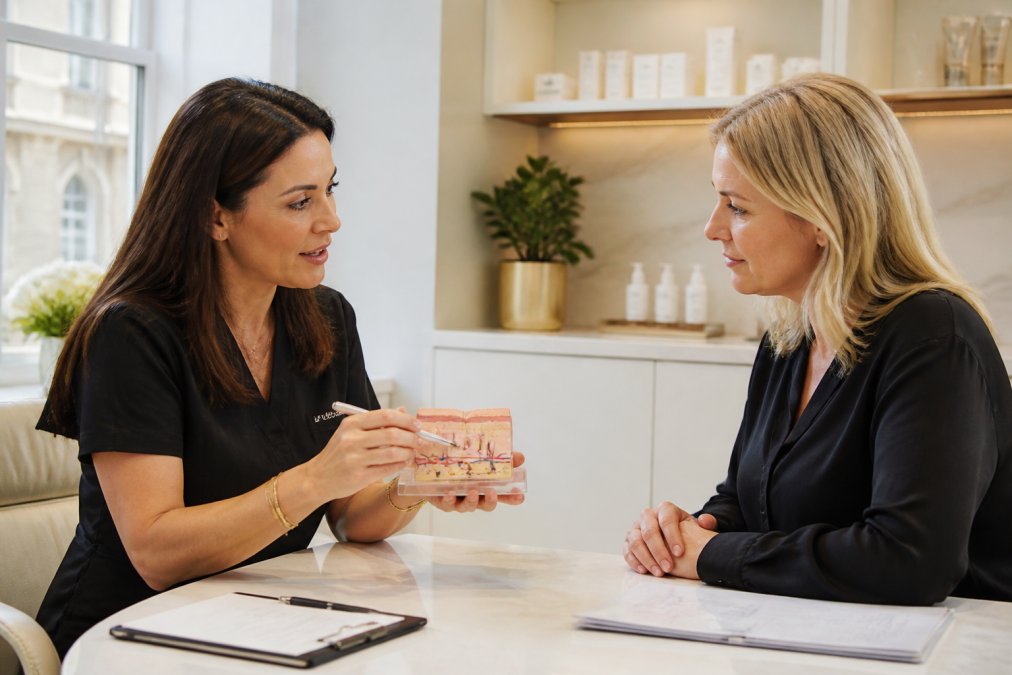
The medical aesthetics consultation process is a structured assessment where a practitioner reviews your medical history, analyses your skin, discusses your goals, and recommends a bespoke plan before anything is agreed. It should never feel like a sales pitch.
Skin Analysis and Bespoke Treatment Planning
Skin analysis uses assessment tools and clinical observation to map your skin's condition, hydration, texture and concerns, then builds a bespoke plan around your goals rather than a fixed package.
Treatments You Can Expect from the Best Aesthetic Clinics in Bath UK
The best aesthetic clinics in Bath UK typically offer evidence-based treatments, from injectables to advanced facials and laser skin resurfacing. Which suits you depends on your concerns, budget and downtime tolerance. Below is what each category involves, so you can compare like for like.
Anti-Wrinkle Injections and Dermal Fillers
Anti-wrinkle injections use prescription-only botulinum toxin to relax specific facial muscles, softening dynamic lines from frowning, squinting or raising your eyebrows, most commonly frown lines, forehead and crow's feet. Dermal fillers use hyaluronic acid gels to restore volume and smooth static lines at rest, most often in cheeks, lips, nasolabial folds and tear troughs.
What to expect in practice:
- Anti-wrinkle injections: results typically begin to show within two to three days and settle over about two weeks. Effects usually last around three to four months, after which the muscle activity gradually returns.
- Dermal fillers: results are visible immediately, though some swelling can take a week or two to settle. Longevity varies by product and area, commonly six to eighteen months.
- Downtime: most people return to normal activity the same day. Temporary redness, swelling or bruising at the injection site is common and usually fades within a few days.
- Follow-up: a review appointment at around two weeks is standard for injectables, so the practitioner can assess the settled result and adjust if needed.
Advanced Facial Treatments and Laser Skin Resurfacing
Advanced facial treatments include HydraFacial, microneedling, and Neogen Plasma, each targeting skin texture, tone, and collagen production. Laser skin resurfacing uses controlled light energy to improve pigmentation, scarring, and fine lines.
A realistic view of the main options:
Book your consultation today →
- HydraFacial: a cleansing, exfoliating and hydrating treatment with no downtime. Often booked as a course of sessions spaced a few weeks apart, or as a pre-event refresh.
- Microneedling: fine needles create controlled micro-injuries to stimulate collagen. A course of three to six sessions, spaced around four to six weeks apart, is typical. Expect redness for a day or two and to avoid active skincare and sun exposure for a short period afterwards.
- Neogen Plasma: uses plasma energy to tighten and resurface. It is a more intensive option with several days of downtime and a course structure.
- Laser skin resurfacing: targets pigmentation, scarring and fine lines. Downtime can range from a day or two to around a week depending on the device and settings, and strict sun protection afterwards is essential.
What These Treatments Cost, and How to Judge Value
Aesthetic pricing in the UK is quoted per area, per session or per course, and varies with product, practitioner seniority and location. Rather than chasing the lowest figure, understand what you are paying for:
- Per-area versus per-session pricing: injectables are usually priced per area or per unit, while facials and laser are priced per session or as a discounted course. A cheap single session can work out more expensive than a course if you need several to see results.
- Product and device choice: branded products and medical-grade devices cost the clinic more, which is reflected in the price. Ask which product or device is being used and why it suits your concern.
- Practitioner time: a longer, unhurried consultation and a conservative, staged plan cost more in practitioner time but reduce the risk of over-treatment and revision.
- Aftercare and review: a price that includes a follow-up review and a written aftercare plan is better value than a lower price with no support if something needs adjusting.
Aftercare, Recovery and Long-Term Skin Health
Aftercare is where many clinics fall short, and it is one of the clearest markers of quality. A good provider gives written instructions, a direct contact for concerns and a scheduled review, knowing what is normal, what is not and when to call protects your result.
Recovery by Treatment Type
Recovery depends on the treatment. Always follow your clinic's written instructions, as timelines vary with product and technique.
- Anti-wrinkle injections: avoid lying flat, strenuous exercise, alcohol and rubbing the treated area for the first few hours. Mild redness or a small bump at the injection site usually settles within hours. Results appear over two to three days and settle by around two weeks.
- Dermal fillers: expect some swelling, tenderness or bruising for a few days, which can be managed with a cool pack (not direct ice) and sleeping slightly elevated. Avoid dental work, facials and strenuous exercise for the first 24 to 48 hours. Swelling is often worst on the second day before improving.
- Microneedling: redness similar to mild sunburn typically settles within 24 to 48 hours. Keep the skin clean and hydrated, avoid active ingredients such as retinol and acids for a few days, and do not apply make-up for the first 24 hours.
- HydraFacial: no real downtime. Some people notice mild redness that fades within hours. Normal skincare can usually resume the same day.
- Laser skin resurfacing and Neogen Plasma: redness, tightness and mild flaking are expected and can last several days to about a week depending on intensity. Strict sun protection is essential, and you will usually be given a specific skincare routine to follow during healing.
Warning Signs: When to Contact Your Clinic
Most side effects are mild and temporary. Contact your clinic promptly if you notice any of the following:
- Severe or worsening pain, or pain that is disproportionate to the procedure
- Intense redness, heat, or swelling that is spreading rather than settling
- Blanching (white patches) or mottled discolouration of the skin after filler
- Blurred vision, severe headache, or skin changes distant from the injection site
- Signs of infection such as pus, fever, or an open wound
- Any reaction you are unsure about, however minor it seems
Long-Term Skin Health and Maintenance
Long-term skin health is a marathon, not a sprint. Consistent sun protection, a suitable skincare routine, and sensible spacing between treatments do more than any single procedure, which is why the best clinics build maintenance plans rather than one-off appointments.
A few principles that hold across most treatments:
- Sun protection is non-negotiable. Daily broad-spectrum SPF protects results and reduces the risk of pigmentation returning after laser or resurfacing.
- Space treatments sensibly. Injectables are usually reviewed and repeated every three to four months, facials and microneedling as a course with maintenance sessions thereafter. Over-treating in a short window rarely improves results and increases risk.
- Keep a simple, consistent routine. A gentle cleanser, a moisturiser suited to your skin type, and sun protection form the base. Add active ingredients gradually and only when your practitioner agrees.
- Keep your medical history current. Tell your practitioner about any new medications, pregnancies, or health changes before each appointment, as these can affect what is safe to offer.
How to Compare Value at the Best Aesthetic Clinics in Bath UK
Value is not the same as the lowest price. When comparing the best aesthetic clinics in Bath UK, weigh the full picture: credentials, prescriber access, CQC registration, consultation quality and aftercare.
| What to Compare | Why It Matters | What Good Looks Like |
|---|---|---|
| Practitioner credentials | Determines skill and accountability | GMC, NMC, or GDC registered |
| Prescriber access | Required for prescription-only treatments | Named prescriber, clear process |
| CQC registration | Signals inspected, accountable care | Verifiable on the CQC register |
| Consultation | Shapes safe, bespoke planning | Unhurried, no pressure to book |
| Aftercare | Protects results and manages risk | Written plan and follow-up review |
Frequently Asked Questions
How do I verify if an aesthetic clinic in Bath is CQC registered?
Check the Care Quality Commission's online register directly. Search the clinic name or provider address and confirm the registration covers the specific treatments offered. CQC registration applies to regulated activities such as surgical procedures, not every non-surgical treatment, so ask the clinic which of its services fall under that registration and which practitioner holds the relevant prescribing qualification. A legitimate provider will answer these questions without hesitation.
Are aesthetic practitioners in the UK required to be medically qualified?
Not all of them. The UK does not currently require every practitioner who delivers anti-wrinkle injections or dermal fillers to hold a medical qualification, though the government has consulted on introducing a licensing scheme. Prescription-only medicines such as botulinum toxin must be prescribed by a qualified prescriber, often a doctor, dentist or independent nurse prescriber. Ask who will assess you, who prescribes, and who carries out the procedure, and confirm their professional registration.
What should I look for during an aesthetic consultation?
A thorough medical aesthetics consultation process should include a full medical history, skin analysis, a discussion of your concerns and goals, and a realistic explanation of what each option can and cannot achieve. The practitioner should outline risks, downtime and aftercare, and be willing to say no to a treatment that is not right for you. If you feel rushed or pushed toward a package, that is a signal to seek a second opinion elsewhere.
What is the difference between a beauty salon and a medical aesthetic clinic?
A beauty salon focuses on cosmetic and relaxation treatments such as facials, waxing and massage. A medical aesthetic clinic delivers clinical procedures, often including injectables, laser skin resurfacing and advanced skin rejuvenation, under the oversight of medically qualified practitioners. Medical clinics should hold appropriate insurance, follow infection control standards, and have a clear pathway for managing complications, including access to prescription medicines if needed.
Choosing where to have aesthetic treatment is a decision about safety as much as appearance, and it deserves more than a quick price check. Exclusive Medical Aesthetics offers personalised, evidence-based care built around subtle, natural-looking results, backed by advanced clinical expertise and a refined patient experience. Get started with Exclusive Medical Aesthetics and book your consultation today to discover the difference.