 how-to
Advanced Clinical Expertise for Aesthetic Procedures
Last Updated: October 23, 2026
Quick Summary
Advanced clinical expertise for aesthetic procedures is the combination of deep anatomical knowledge, evidence-based judgement and supervised hands-on experience that lets a practitioner choose, plan and deliver non-surgical treatments safely. At Exclusive Medical Aesthetics, we treat it as the difference between operating a device and understanding a face.
- Aesthetic practitioner qualifications should include a recognised clinical background, formal modality training and supervised practice.
- Supervision should involve a named supervisor, direct observation of early cases and written sign-off.
- An aesthetic procedure consultation is a structured clinical assessment covering anatomy, suitability and informed consent.
- Vascular occlusion, vision changes and spreading infection after treatment need same-day review, not a wait-and-see approach.
- Ask any clinic to explain its escalation protocol before you book a treatment.
Table of Contents
- What Advanced Clinical Expertise Means in Aesthetic Practice
- Aesthetic Practitioner Qualifications: Training, Supervision and Competency
- The Aesthetic Procedure Consultation: Assessment, Anatomy and Consent
- Choosing the Right Procedure: Injectables, Lasers and Energy Devices
- Aesthetic Treatment Risks and Aftercare: Prevention and Escalation
- Long-Term Skin Health: Measuring Outcomes and Patient Experience
- Conclusion
- Frequently Asked Questions
What Advanced Clinical Expertise Means in Aesthetic Practice
Advanced clinical expertise for aesthetic procedures is the combination of deep anatomical knowledge, evidence-based judgement and supervised hands-on experience that lets a practitioner choose, plan and deliver non-surgical treatments safely.
That distinction matters. Many clinics can switch on a laser or draw up a dermal filler.
Below, we break down what genuine expertise looks like, how practitioners build it, and what you should expect from anyone treating your skin.
Aesthetic Practitioner Qualifications: Training, Supervision and Competency
Aesthetic practitioner qualifications should include a recognised clinical or nursing background, formal training in each modality, and a period of supervised practice before independent work. In the UK, non-surgical aesthetic treatments sit under a patchwork of regulation, so a practitioner's own standards carry real weight.
A common mistake is assuming a certificate equals competence. It does not. Competency assessment usually combines observed technique, case logs and complication drills.
The pathway from foundational to advanced practice
Most practitioners who reach advanced clinical expertise follow a recognisable progression rather than a single course. The sequence tends to look like this:
- Core clinical qualification, a registrable qualification in medicine, nursing, dentistry or an equivalent regulated profession, with an active professional registration.
- Foundational aesthetics training, face-to-face teaching in anatomy, consultation, consent and basic injectable technique, usually with a written and practical assessment.
- Supervised practice, a defined number of observed cases per modality, with a named mentor who reviews technique, complication management and treatment planning. Case logs and mentor sign-off are the evidence that this happened.
- Competency assessment, direct observation of technique (often called DOPS), case-based discussion, and complication drills such as managing a vascular occlusion or anaphylaxis.
- Independent practice with audit, once signed off, the practitioner records outcomes, adverse events and revisions, and reviews them at intervals.
- Advanced modality training, cannula techniques, deeper planes, energy-device parameters and combination planning, each with its own supervised case requirement.
A weekend course can sit inside step two. It cannot substitute for steps three and four, and any provider that implies otherwise is selling a certificate, not a competence.
What supervision should actually involve
Supervision is not simply having a senior colleague in the building. Good supervision has structure:
- A named supervisor with relevant modality experience and their own documented outcomes
- A defined case mix covering common presentations and at least some higher-risk anatomy
- Direct observation of early cases, then indirect oversight with review of records
Ask a practitioner who supervised their early cases, how many were observed, and what the sign-off covered. Specific answers are a good sign; vague ones are not.
Regulation, indemnity and scope of practice
There is no single UK statute that licenses non-surgical aesthetic procedures in the way that, for example, dentistry is regulated. Instead, several layers apply:
- Professional regulators, the General Medical Council, Nursing and Midwifery Council, General Dental Council and their equivalents set standards for registered professionals, including duties around consent, record-keeping and working within competence.
- Devices and medicines, botulinum toxin is a prescription-only medicine, so its supply and administration must fit within prescribing and exemption rules. Dermal fillers are regulated as medical devices, and the Medicines and Healthcare products Regulatory Agency (MHRA) oversees device safety and adverse-event reporting.
- Local authority oversight, some premises offering special treatments, including certain aesthetic procedures, need registration or licensing with the local authority, and requirements vary by area (Massage and special treatment premises licensing).
- Indemnity insurance, most policies specify which procedures and supervision arrangements they cover. A practitioner whose insurance does not cover a procedure should not be performing it.
This is why scope of practice is personal rather than generic. Two practitioners with the same job title may legitimately be able to offer different procedures based on their registration, training, supervision history and indemnity cover.
Book your consultation today →
Medical oversight and clinical decision-making should sit behind every treatment plan, not just the hands-on work. A practitioner who can explain their training pathway, their supervisor and their scope of practice is usually the one who will also explain your treatment plan honestly.
The Aesthetic Procedure Consultation: Assessment, Anatomy and Consent
An aesthetic procedure consultation is a structured clinical assessment, not a sales conversation.
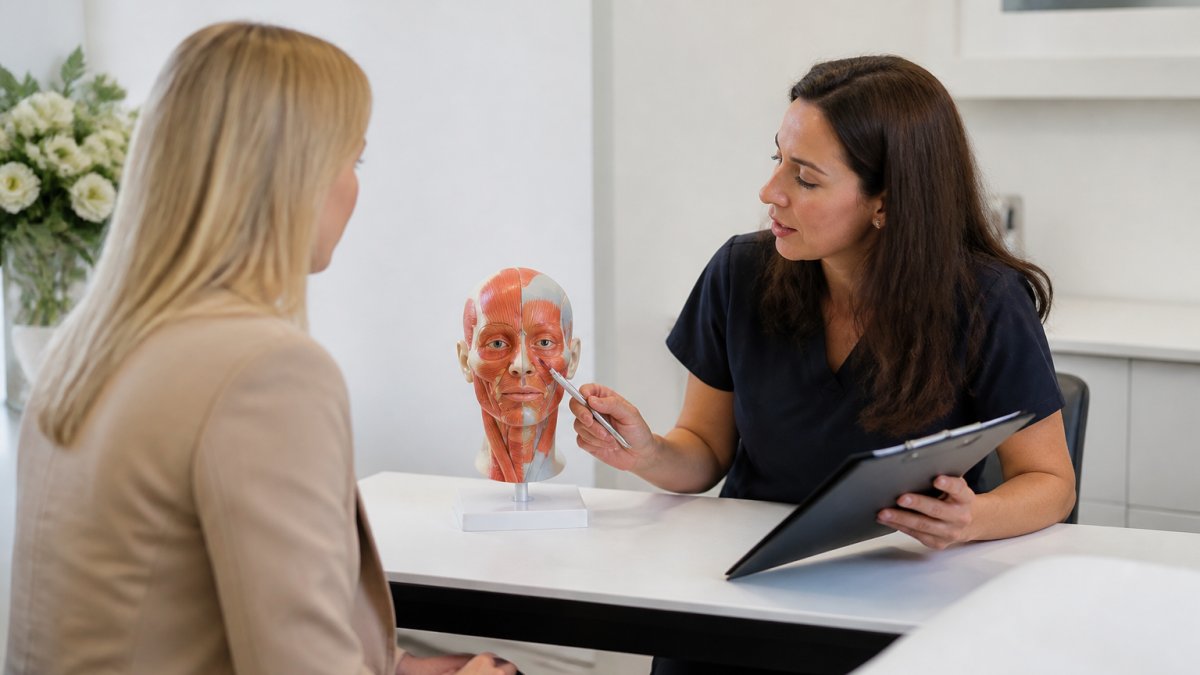
Facial anatomy drives everything here.
What most guides miss is the honesty piece. A good consultation should tell you when a treatment is not right for you, not just which one to buy.
Our consultation workflow follows a simple order:
- Assess skin health, volume loss and facial movement
- Screen for patient suitability and medical history
- Explain realistic outcomes and downtime
- Discuss risks, alternatives and aftercare
- Record informed consent in writing
Documentation protects you as much as the clinic. Ask what gets recorded and where.
Choosing the Right Procedure: Injectables, Lasers and Energy Devices
Choosing the right procedure comes down to matching the concern to the mechanism. Neuromodulators such as Botulinum toxin work on dynamic lines. Dermal fillers restore volume.
Aesthetic procedures are not interchangeable. Melasma behaves differently from sun damage. Acne scars need a different approach to fine lines. This is where clinical judgement earns its keep.
Here is a rough map of the main non-surgical treatments:
| Concern | Typical Modality | Notes |
|---|---|---|
| Dynamic lines | Neuromodulators | Softens movement, not volume |
| Volume loss | Dermal fillers | Facial assessment essential |
| Dullness, hydration | Skin boosters, microneedling | Builds over sessions |
| Pigmentation, melasma | Light-based treatments, IPL | Needs careful case selection |
| Skin laxity | Radiofrequency, HIFU | Gradual tightening |
| Texture, scarring | Microneedling, chemical peels | Often combined |
| Stretch marks | Microneedling, acoustic wave therapy | Gradual improvement |
Comparative procedure selection should always follow assessment, not precede it. NHS guidance on cosmetic procedures is a sensible starting point for understanding what is regulated and what is not.
Aesthetic Treatment Risks and Aftercare: Prevention and Escalation
Aesthetic treatment risks range from common, mild reactions to rare but serious complications. Prevention starts with patient suitability, careful technique and clear aftercare instructions. Escalation means knowing exactly when to call for help.
Complication recognition is a skill in itself. Redness and swelling are expected. Spreading blanching, pain out of proportion or vision changes are not. These need urgent review.
Prevention: what good practice looks like before the needle or device
Most serious complications are prevented before treatment starts. The practical controls are unglamorous but effective:
Book your consultation today →
- Suitability screening, medical history, medications (including anticoagulants), allergies, pregnancy status, active infection and previous aesthetic treatments.
- Anatomical planning, mapping danger zones, choosing cannula versus needle where appropriate, and using the lowest effective volume or energy setting.
- Aseptic technique, skin preparation, sterile fields for injectables, and single-use needles and cannulae.
- Product and device checks, batch numbers, expiry dates, dilution records and device calibration logged before use.
Recognition: the signs that change the plan
Expected reactions, mild redness, swelling, tenderness, small bruises, usually settle within days. The signs below should trigger a same-day review rather than a wait-and-see approach:
- Vascular occlusion, blanching that does not refill, mottled or dusky skin, pain out of proportion to the procedure, or slow capillary refill. This is a time-critical emergency in filler treatment.
- Vision changes, any visual disturbance after facial filler is an emergency and needs immediate hospital assessment.
- Infection, spreading redness, warmth, fever, purulent discharge or increasing pain after the first 48-72 hours.
- Hypersensitivity, urticaria, facial swelling away from the treatment area, wheeze or difficulty breathing.
Escalation: a protocol, not a promise
A credible clinic can describe its escalation pathway in specific terms. A workable protocol usually includes:
- Immediate action, stop the procedure, assess the patient, and follow the modality-specific emergency algorithm (for example, the recognised hyaluronidase protocol for filler vascular occlusion).
- Direct contact, a named clinical contact reachable within the first 72 hours, with a response time the clinic commits to.
- Senior review, access to a more experienced clinician or medical oversight for anything outside the treating practitioner's competence.
- Emergency referral, a clear route to urgent care or emergency services, with the patient's records and treatment details ready to hand over.
- Documentation, a contemporaneous record of the event, the actions taken, the advice given and the outcome, plus reporting to the MHRA where a device or product is implicated.
- Review and learning, a case review that feeds back into the clinic's protocols.
Aftercare as part of the clinical record
Aftercare is not a leaflet; it is part of the treatment record. Good practice includes written instructions tailored to the procedure, expected timelines for swelling and bruising, when to resume exercise, skincare and makeup, and explicit red-flag symptoms that mean calling the clinic rather than waiting.
Risk management is not a disclaimer. It is a workflow, and it should be visible to you as a patient.
Long-Term Skin Health: Measuring Outcomes and Patient Experience
Long-term skin health depends on maintenance, realistic expectations and honest measurement. Single treatments rarely solve a concern. Personalised treatment plans that build over months tend to hold up better.
The real difference between good and excellent care often comes down to how outcomes are tracked. We favour a simple approach:
- Baseline photographs taken under consistent lighting
- Patient-reported experience captured at each review
- Objective skin measures where relevant
- Plan adjustments based on what the results actually show
NICE guidance on safe and effective cosmetic practice supports the principle that decisions should follow evidence, not marketing. Measuring clinical outcomes and patient experience keeps that honest.
Conclusion
Building genuine clinical expertise takes time, supervision and a refusal to cut corners. If you want subtle, evidence-based results, the practitioner behind the treatment matters more than the device. Exclusive Medical Aesthetics offers advanced clinical expertise, personalised care and evidence-based treatments designed for elegant, natural-looking results. Book your consultation today and get a plan built around your skin, not a menu.
Frequently Asked Questions
What qualifications should an aesthetic practitioner have?
Look for a registered healthcare professional, such as a doctor, dentist or nurse, with verifiable training in the specific treatments offered. Aesthetic practitioner qualifications should include supervised hands-on practice, competency assessment and ongoing continuing professional development. Ask which regulated body the practitioner belongs to, whether they hold indemnity insurance, and who provides medical oversight if complications occur. A practitioner who can explain their training pathway clearly, and who declines treatments outside their competence, is usually the safer choice.
What should happen during an aesthetic procedure consultation?
A thorough aesthetic procedure consultation covers your medical history, medications, allergies and previous treatments, followed by a facial assessment of skin quality, volume and anatomy. The practitioner should discuss realistic options, explain risks and downtime, and confirm your consent in writing. Expect them to be honest if a treatment is not right for you. If a consultation feels rushed or you are pushed towards a package before your concerns are addressed, that is a reason to pause and seek a second opinion.
What should aftercare include following an aesthetic procedure?
Good aesthetic treatment risks and aftercare planning starts before treatment, not after. You should leave with written instructions covering expected side effects, warning signs that need urgent review, skincare to avoid, sun protection and when to return for review. Ask for a direct contact route if something concerns you out of hours. Follow-up appointments matter too, because they let the practitioner assess healing and adjust your long-term skin health plan rather than judging results on day one.
How can aesthetic treatments support long-term skin health?
Treatments work best as part of a plan rather than one-off events. A clinician should combine procedures such as skin boosters, microneedling or light-based treatments with a home routine built around sun protection, gentle cleansing and evidence-based actives. Reviewing progress at intervals lets them adjust the plan as your skin changes. The aim is gradual, natural-looking improvement that holds up over years, not a dramatic result that fades within weeks.