 how-to
Why Personalized Aesthetic Plans Matter in 2026
Table of Contents
- Why Personalized Aesthetic Plans Matter More Than Ever
- How Individual Needs and Skin Types Shape Your Plan
- Aesthetic Consultation Questions to Ask Before Any Treatment
- Building Your Personalised Aesthetic Treatment Plan: A Step-by-Step Process
- Safety, Candidacy and Realistic Outcomes in Aesthetic Medicine
- How to Achieve Natural-Looking Aesthetic Results
- Measuring Progress: The Aesthetic Treatment Plan Review
- Conclusion: Why a Tailored Approach Delivers Lasting Confidence
- Frequently Asked Questions
Last Updated: October 12, 2026
Why Personalized Aesthetic Plans Matter More Than Ever
Personalized aesthetic plans are treatment programmes built around one person's skin, facial structure, medical history and goals, rather than a fixed menu of procedures. This guide from Exclusive Medical Aesthetics explains why that difference decides how natural your results look. The shift away from one-size-fits-all treatment is the single biggest change in aesthetic medicine over the past decade. Injecting the same filler volume into every face produces the same result: faces that look treated rather than refreshed.
The reasons are practical, not fashionable:
- Skin type, thickness and healing speed vary enormously between people
- Bone structure and fat distribution change how any treatment reads on the face
- Medical history and medications affect what is safe for you
- Goals differ: some want prevention, others correction, most want neither to be obvious
A tailored plan accounts for all four. A standard package accounts for none.
How Individual Needs and Skin Types Shape Your Plan
Your skin type and concerns should decide the treatment, not the other way round. Oily, dry, sensitive and combination skin all respond differently to the same active ingredients and the same devices. So do different ages. A woman in her thirties dealing with early fine lines needs a very different plan from a woman in her sixties addressing skin laxity and volume loss.
Age changes the target as much as the skin does. In your thirties and forties, prevention and skin health usually lead. From your fifties onward, collagen loss, hydration and facial volume become the main focus.
Skin tone matters too. Some laser and light-based treatments carry a higher risk of pigmentation changes on deeper skin tones, so device settings and treatment choice need adjusting. A plan that ignores this is not personalised, it is generic.
Aesthetic Consultation Questions to Ask Before Any Treatment
Ask these questions at your consultation, before you commit to anything. A practitioner who welcomes them is a practitioner worth staying with. The General Medical Council guidance on good medical practice sets out the standards patients should expect from any doctor, including clear communication about risks and alternatives. The Care Quality Commission standards for cosmetic procedures require providers to give you clear information about risks and aftercare before you consent. Use both as your benchmark.
Bring this list to your appointment:
- What are you recommending, and why this treatment for my skin specifically?
- What results are realistic for me, and over what timeframe?
- What are the risks and side effects, and how common are they?
- How much downtime should I plan for?
- What happens if I am not happy with the result?
- Who will carry out the treatment, and what are their qualifications?
- What would you recommend I do instead, if anything?
- What is the full cost, including review appointments and any corrective work?
- How will you record and store my photographs and clinical notes?
- If I want to pause or stop, how do I do that without pressure?
That last question matters most. An honest practitioner will sometimes tell you a treatment is not right for you.
On cost and prioritisation. Aesthetic treatment is rarely a single purchase. A realistic plan might span six to twelve months, with costs spread across several appointments. Ask for the total figure, not the per-session figure. If the total is beyond your budget, ask which single step would deliver the most visible improvement for the least money. A good practitioner will prioritise skin health and prevention first, because those underpin everything else and are usually the cheapest to maintain.
On qualifications. In the UK, the title "doctor" is protected, but "aesthetic practitioner" is not. Ask whether the person treating you is on the General Medical Council register, the Nursing and Midwifery Council register, or another statutory register. If they are not, ask who supervises them and what happens if something goes wrong. Insurance arrangements matter too: ask whether the practitioner holds indemnity cover for the specific treatment they are proposing.
On data and technology. Some clinics use AI or imaging tools to analyse skin and suggest treatments. These can be useful, but they are aids, not diagnoses. Ask what data the tool collects, whether it is shared with third parties, and whether a human clinician reviews the output before any treatment is agreed. Under the UK GDPR, you can request a copy of your data and ask for it to be deleted, subject to the clinic's legal retention obligations.
Building Your Personalised Aesthetic Treatment Plan: A Step-by-Step Process
A personalised aesthetic treatment plan is built in stages, starting with assessment and ending with a review. Rushing any stage is what produces results that look artificial. Here is how we approach it at Exclusive Medical Aesthetics.
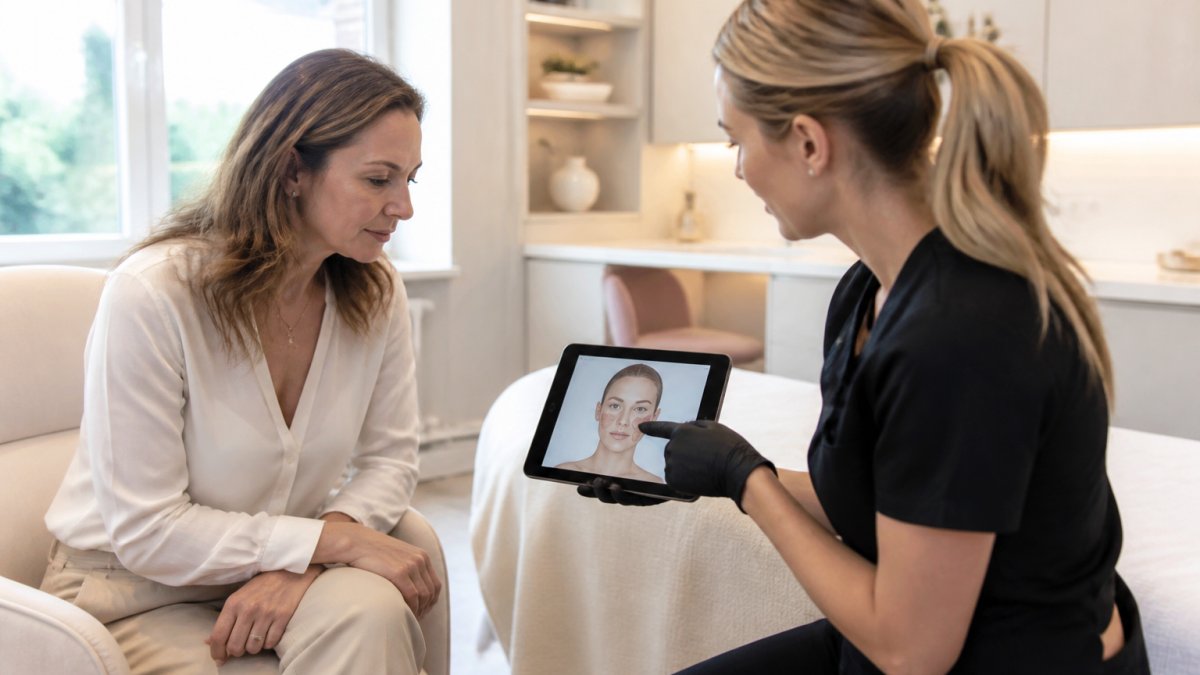
Step 1: Full assessment. Your practitioner reviews your skin, facial structure, medical history and medications. This is also where baseline photographs are taken and stored securely, and where you should be asked for written consent to hold your clinical data.
Step 2: Define your goals. You say what you want to change and, just as importantly, what you want to avoid. Good practitioners will push back here. If you ask for something that does not suit your anatomy or your stage of life, the plan should say so rather than simply take the booking.
Step 3: Agree the plan. You get a written sequence of treatments, with realistic timeframes and costs. That written plan should include:
- The specific treatments proposed, in order, and why each one was chosen for you
- The number of sessions likely needed, and the interval between them
- An itemised cost, including any review appointment fees
- What happens if you decide to stop partway through
- The name and registration status of the practitioner carrying out each stage
Step 4: Treat in stages. Small, measured steps let your practitioner adjust as your skin responds. This is where personalisation earns its keep. A plan that treats everything in one sitting removes the ability to observe how your skin reacts and to calibrate the next step. Most practitioners find that spacing treatments over weeks, not days, produces more natural results and fewer corrections.
Step 5: Review and refine. Progress is checked against your original goals, and the plan changes if needed. A review is not a sales appointment. It is a clinical checkpoint. If the plan is working, you continue. If it is not, you change it. If the goal has been met, you stop.
Book your consultation today →
Step 6: Maintain, do not escalate. Once a result is achieved, the temptation is to keep adding. The better approach is maintenance: fewer treatments, longer intervals, and a focus on skin health between appointments. This is where a personalised plan saves money as well as faces.
Safety, Candidacy and Realistic Outcomes in Aesthetic Medicine
Not everyone is a suitable candidate for every treatment, and a good plan says so upfront. Candidacy depends on your medical history, medications, allergies, skin condition and, for some treatments, pregnancy. Certain blood-thinning medications, active skin infections and autoimmune conditions can rule a treatment out or change how it is delivered.
Realistic outcomes matter just as much as safety. Results are gradual, rarely dramatic, and they fade. Fillers are broken down by the body over time. Botulinum toxin wears off. Skin treatments build improvement over a course, not in a single session.
The Care Quality Commission standards for cosmetic procedures require providers to give you clear information about risks and aftercare before you consent. Use that as your benchmark.
How to Achieve Natural-Looking Aesthetic Results
Natural-looking aesthetic results come from restraint, not from bigger doses. The most common mistake in aesthetic medicine is treating too much, too fast, in too many areas at once. Subtle enhancement works because it preserves your expressions and your proportions.
What that looks like in practice:
- Treat one area at a time and assess before adding more
- Start conservatively; you can always add, rarely subtract
- Match treatment to your facial structure, not to a trend
- Prioritise skin quality and hydration alongside any injectable work
- Keep your own features recognisable
The goal is a refreshed version of your face. Anyone who can name the treatment you had has been over-treated.
Measuring Progress: The Aesthetic Treatment Plan Review
Progress should be measured against your original goals, not against a general standard of beauty. That is why the review stage matters. At a review appointment, your practitioner compares your current result with your starting point and your stated aims.
What a review typically covers:
- Photographs or notes from your first assessment, compared with now
- Whether the result matches what you asked for
- How your skin has responded, including any side effects
- Whether the next stage should proceed, change or stop
- Anything you want adjusted
Plans are meant to change. Skin changes with seasons, hormones, stress and age. A plan that never gets reviewed is not personalised anymore, it is just a schedule.
Conclusion: Why a Tailored Approach Delivers Lasting Confidence
The challenge with aesthetic treatment is not finding a clinic that offers it. It is finding one that treats your face as yours. A plan built around your skin, your history and your goals delivers results that look like you on a good day, not like a procedure.
At Exclusive Medical Aesthetics, we build every plan around advanced clinical expertise, personalised care and evidence-based treatments. Our focus is elegant, natural-looking results, achieved through subtle enhancement rather than over-treatment.
Book your consultation today to discover the difference a tailored plan makes.
Frequently Asked Questions
How does a personalised aesthetic treatment plan work?
A personalised aesthetic treatment plan starts with a detailed consultation covering your skin type, concerns, medical history, and goals. The practitioner then recommends a combination of treatments and at-home care tailored to you. For example, a plan for early signs of ageing might focus on preventative measures like microneedling, while a plan for volume loss could include dermal fillers. The plan is reviewed regularly to track progress and adjust as your skin changes. This approach ensures treatments are safe, effective, and aligned with your individual needs.
What should be discussed during an aesthetic consultation?
During an aesthetic consultation, you should discuss your medical history, current skincare routine, allergies, and any previous treatments. Be clear about your goals, whether that's reducing fine lines or improving skin texture. Ask about the practitioner's qualifications and experience with the recommended treatments. You should also cover potential risks, downtime, and costs. A thorough consultation ensures your plan is safe and realistic. At Exclusive Medical Aesthetics, we encourage open dialogue so you feel confident and informed before proceeding.
How often should an aesthetic treatment plan be reviewed?
Most aesthetic treatment plans benefit from a review every 3 to 6 months, depending on the treatments involved and your skin's response. For example, after a course of skin boosters, a review at 3 months helps assess hydration and glow. Injectable treatments may need a review at 4 to 6 months as effects settle. Regular reviews allow your practitioner to adjust the plan, maintain results, and address any new concerns. They also ensure you're not over-treating. Your clinic will recommend a schedule tailored to your plan.
Why should aesthetic treatments be tailored to the individual?
Facial anatomy, skin type, and ageing patterns vary widely. A treatment that works well for one person may be ineffective or even risky for another. For instance, deeper injections suit volume loss in the mid-face, while superficial peels address pigmentation. Tailoring also respects your comfort level and downtime. A personalised aesthetic plan considers your unique features and goals, delivering natural-looking aesthetic results rather than a uniform, 'done' appearance. This individualised approach is central to safe, effective aesthetic medicine.