 Listicle
What Is the Best Skincare Routine to Maintain Aesthetic Results?
Last Updated: October 29, 2026
Quick Summary
The best skincare routine to maintain aesthetic results at home is a short, consistent daily sequence of gentle cleansing, an antioxidant serum in the morning, retinol two to three evenings a week, and daily SPF50+. Consistency beats intensity, so a simple routine done every day outperforms an elaborate one done twice a week.
- Apply roughly two finger-lengths of SPF50+ to the face and neck, reapplying every two hours outdoors.
- Keep vitamin C in the morning and retinol at night to reduce stinging and redness.
- After treatments, strip back to a gentle cleanser, barrier-supporting moisturiser and SPF50+.
- Reintroduce products one at a time, every few days, starting with the mildest.
- Use a weekly gentle exfoliation only if your skin tolerates it.
Table of Contents
- Why Your At-Home Skincare Routine Decides How Long Aesthetic Results Last
- The Morning Skincare Routine That Protects Your Investment
- The Evening Skincare Routine That Supports Repair and Renewal
- Skincare After Aesthetic Treatments: Timelines and Aftercare That Protect Results
- How to Layer Retinol with Vitamin C Without Irritation
- Building a Skincare Routine for Your Skin Type and Treatment History
- Maintenance Schedules and Realistic Expectations Between Appointments
- Book a Consultation to Personalise Your Maintenance Plan
- Frequently Asked Questions
Why Your At-Home Skincare Routine Decides How Long Aesthetic Results Last
Aesthetic treatments create the change. Your skincare routine is what keeps it. Results from in-clinic work tend to fade fastest when skin is treated as an afterthought at home. The best skincare routine to maintain aesthetic results at home is not the most expensive one. It is the one you actually follow, morning and night, with the right products in the right order.
A maintenance skincare routine is the daily sequence of cleansing, treating, hydrating and protecting steps that preserves skin health between professional appointments. It works by supporting the skin barrier, managing hydration and limiting UV damage, which are the same factors that determine how long clinical results look fresh.
Below, we break down what to do each morning and evening, how to care for skin after treatment, and how to build a plan around your own skin type and treatment history.
The Morning Skincare Routine That Protects Your Investment
Your morning routine has one job above all others: defence. Sun exposure is the single biggest driver of how quickly aesthetic results look tired, so the morning sequence is built around protection first and treatment second.
The morning sequence, in order
Apply products from thinnest to thickest, and give each one a moment to settle before the next.
- Cleanse. A gentle cleanser is enough for most skin in the morning. If your skin is dry or reactive, a lipid-replenishing cleansing oil or a rinse with lukewarm water may suit better than a foaming wash.
- Antioxidant serum. Apply while skin is still slightly damp. Vitamin C serums are the standard choice, and SkinCeuticals' guidance on antioxidant use explains how vitamin C, vitamin E and ferulic acid work together against UV and pollution damage.
- Hydrating serum (optional). A hyaluronic acid or glycerin-based serum adds water-binding support, particularly if your skin feels tight.
- Eye cream. A small amount around the orbital bone, patted rather than rubbed.
- Moisturiser. Choose a texture suited to your skin type, lighter gels for oily skin, richer ceramide creams for dry skin.
- SPF50+ broad-spectrum. This is the non-negotiable step. Use roughly two finger-lengths for the face and neck, and reapply every two hours if you are outdoors or near windows for long periods.
Morning versus evening: what changes
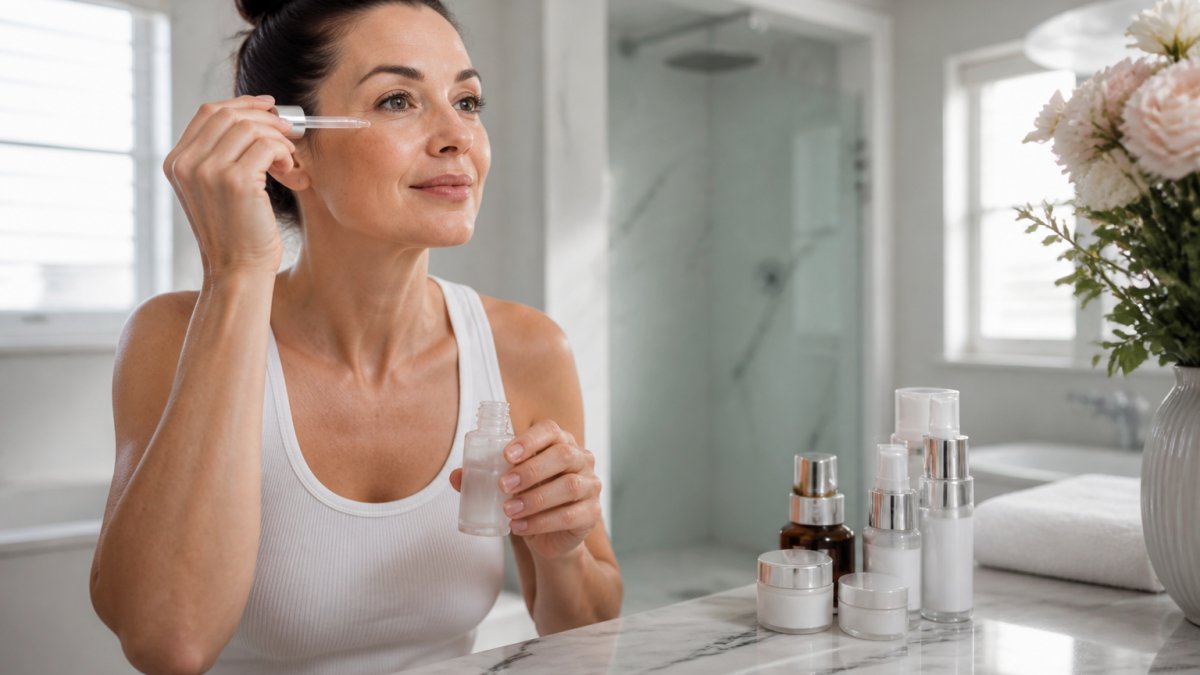
The morning routine is about defence; the evening routine is about repair. That means vitamin C and SPF belong in the morning, while retinol and richer moisturisers belong at night. Exfoliating acids are best kept to the evening, and only on the nights your skin tolerates them. Keeping these two categories separate reduces irritation and makes each product work harder.
Common morning mistakes
- Applying SPF as the only protection on a cloudy day, UV passes through cloud, so daily SPF50+ still matters.
- Layering too many serums at once, which can pill under makeup and irritate sensitive skin.
- Skipping moisturiser because skin feels oily, dehydrated skin often produces more oil, not less.
The Evening Skincare Routine That Supports Repair and Renewal
Evening is when the skin repairs itself, so the evening skincare routine should be about support rather than aggression. Remove sunscreen and makeup properly, cleanse gently, then layer treatment products from thinnest to thickest: serum first, then eye cream, then moisturiser. If your skin tolerates it, retinol belongs here rather than in the morning. For guidance on when and how to introduce it, read at what age to start using retinol.
A common mistake is stacking too many actives at night. Exfoliating acids, retinol and vitamin C used together on the same evening is a recipe for redness and irritation.
Skincare After Aesthetic Treatments: Timelines and Aftercare That Protect Results
General skincare advice often stops short of what to do in the days after an in-clinic treatment, when skin can be most sensitive. The routines below are general guidance only, your practitioner's written aftercare instructions always take precedence, because the right timeline depends on the treatment, the depth, the product used and your skin's response.
Why aftercare differs by treatment
Aesthetic treatments temporarily disrupt the skin barrier to varying degrees. The more disruption, the longer you need to pause actives and the more conservative your routine should be. Returning to retinol or exfoliating acids too soon can prolong redness and irritation after a treatment.
General aftercare timelines by treatment type
Use these as a rough framework, not a substitute for your provider's instructions.
- Injectables (anti-wrinkle injections and dermal fillers): Keep the treated area clean and avoid rubbing or massaging unless told otherwise. Aftercare guidance for injectables varies, so follow your practitioner's written instructions on activity and rest after treatment. Skincare can usually resume gently the same day, but skip strong actives over the treated area for a few days.
- Chemical peels (superficial): Expect mild tightness and flaking for a few days. Cleanse with a gentle, non-foaming cleanser, use a barrier-supporting moisturiser, and apply SPF50+ diligently. Pause retinol, exfoliating acids and vitamin C until flaking settles, and confirm timing with your practitioner.
- Laser and light treatments: Skin may feel warm and sensitive for several days. Keep the routine minimal: gentle cleanser, soothing moisturiser, SPF50+. Avoid actives, exfoliation, hot baths and saunas until cleared. Some treatments require longer downtime than others, so follow the specific advice given.
- Microneedling: Skin is more permeable for a short window, so keep products simple and sterile-feeling. Pause actives and exfoliation until sensitivity has fully settled, and follow your practitioner's advice on makeup and timing.
What to use during recovery
Strip the routine back to three steps: a gentle cleanser, a barrier-supporting moisturiser and SPF50+. Look for ingredients such as ceramides, glycerin, panthenol and postbiotic or copper-zinc complexes, which help calm the appearance of redness. Avoid fragrance, essential oils, physical scrubs, retinoids, AHAs and BHAs until your skin feels normal again.
When to reintroduce your usual routine
Reintroduce one product at a time, every few days, starting with the mildest. If stinging, redness or flaking returns, step back. This gradual approach protects both your skin barrier and the result you have invested in, and it is far safer than resuming a full actives stack the moment the skin stops feeling tight.
Book your consultation today →
Questions worth asking your practitioner
Before you leave the clinic, ask: which products should I pause, and for how long? When can I resume retinol and acids? How much sunscreen should I apply, and how often? What signs mean I should call you? A good provider will give you written aftercare instructions, keep them somewhere you will actually see them.
How to Layer Retinol with Vitamin C Without Irritation
The safest way to layer retinol with vitamin C is to separate them: vitamin C in the morning, retinol at night. Both are effective, but used together in the same layer they increase the risk of stinging and redness, particularly on sensitive skin.
If your skin is sensitive, start with a lower-strength retinol and build up gradually, two nights a week at first. Patch testing behind the ear before a full application is a simple habit worth keeping. Readers who find retinol too harsh may prefer our guide to natural alternatives to retinol for sensitive skin.
Building a Skincare Routine for Your Skin Type and Treatment History
There is no universal routine, and anyone who tells you otherwise is selling something. Oily skin tolerates lighter moisturisers and gel cleansers; dry skin needs richer, ceramide-based products. A personalised aesthetic plan matters because your treatment history changes what your skin needs next, and a look at why personalised plans matter explains that reasoning in more depth.
A personalised approach, built around your skin rather than a template, is the aim.
Maintenance Schedules and Realistic Expectations Between Appointments
Consistency beats intensity. A short routine done every day will outperform an elaborate one done twice a week. Realistic maintenance looks like this:
- Cleanse gently twice daily
- Antioxidant serum each morning
- Retinol two to three evenings a week, adjusted to tolerance
- SPF50+ every day, reapplied if you are outdoors
- A weekly gentle exfoliation only if your skin tolerates it
- Professional review at intervals your practitioner recommends
Results build gradually, and expecting dramatic change in a fortnight leads to disappointment and over-treatment.
A realistic maintenance routine comes down to a short list of habits done consistently.
| Step | Frequency |
|---|---|
| Cleanse gently | Twice daily |
| Antioxidant serum | Each morning |
| Retinol | Two to three evenings a week, adjusted to tolerance |
| SPF50+ | Every day, reapplied if outdoors |
| Gentle exfoliation | Weekly, only if skin tolerates it |
| Professional review | At intervals your practitioner recommends |
Book a Consultation to Personalise Your Maintenance Plan
Generic routines only go so far. Your skin type, sensitivity and treatment history all shape what will actually work, and guessing costs both money and progress. Maintenance plans can be tailored to your skin, and our team is glad to discuss what might suit you. When you are ready, you can book a professional aesthetic consultation in Bath.
Book your consultation today to discuss a maintenance plan tailored to your skin.
Frequently Asked Questions
How can I maintain aesthetic treatment results at home?
A consistent skincare routine is the foundation. Use a gentle cleanser twice daily, a barrier-supporting moisturiser, and broad-spectrum SPF 50 every morning. Introduce one active ingredient at a time, such as retinol or vitamin C, and follow any aftercare instructions from your practitioner. Avoid over-exfoliating and keep your skin hydrated. Book regular review appointments so your clinician can adjust your plan as your skin changes.
What should I use in the morning and evening after an aesthetic treatment?
In the first 48 to 72 hours, follow your clinic's specific aftercare advice. Generally, use a gentle, fragrance-free cleanser and a restorative moisturiser. Avoid actives like retinol, vitamin C, and exfoliating acids until your practitioner confirms your skin has recovered. Once cleared, return to your morning skincare routine with antioxidants and SPF, and your evening skincare routine with retinoids or gentle exfoliants. Patch test any new product first.
Can I use retinol and vitamin C in the same routine?
Yes, but timing matters. Vitamin C works best in the morning for antioxidant protection against UV and pollution, while retinol is better suited to the evening because sunlight can degrade it and increase sensitivity. If you prefer to use both in the evening, apply vitamin C first, wait a few minutes, then apply retinol. Always introduce one at a time and use a pea-sized amount of retinol to minimise irritation.
How long does it take for a skincare routine to show results?
Visible changes from consistent use usually take several weeks, so give your routine time before judging results. Hydration improvements may appear within days, but fine lines and pigmentation need longer. Photographic progress tracking and regular check-ins with your practitioner help set realistic expectations and confirm the routine is working.
Maintaining aesthetic results at home comes down to consistency, the right product order, and honest advice about what your skin actually needs. If you would like a plan built for your skin rather than a generic template, get started with Exclusive Medical Aesthetics and book a consultation with our clinical team.